
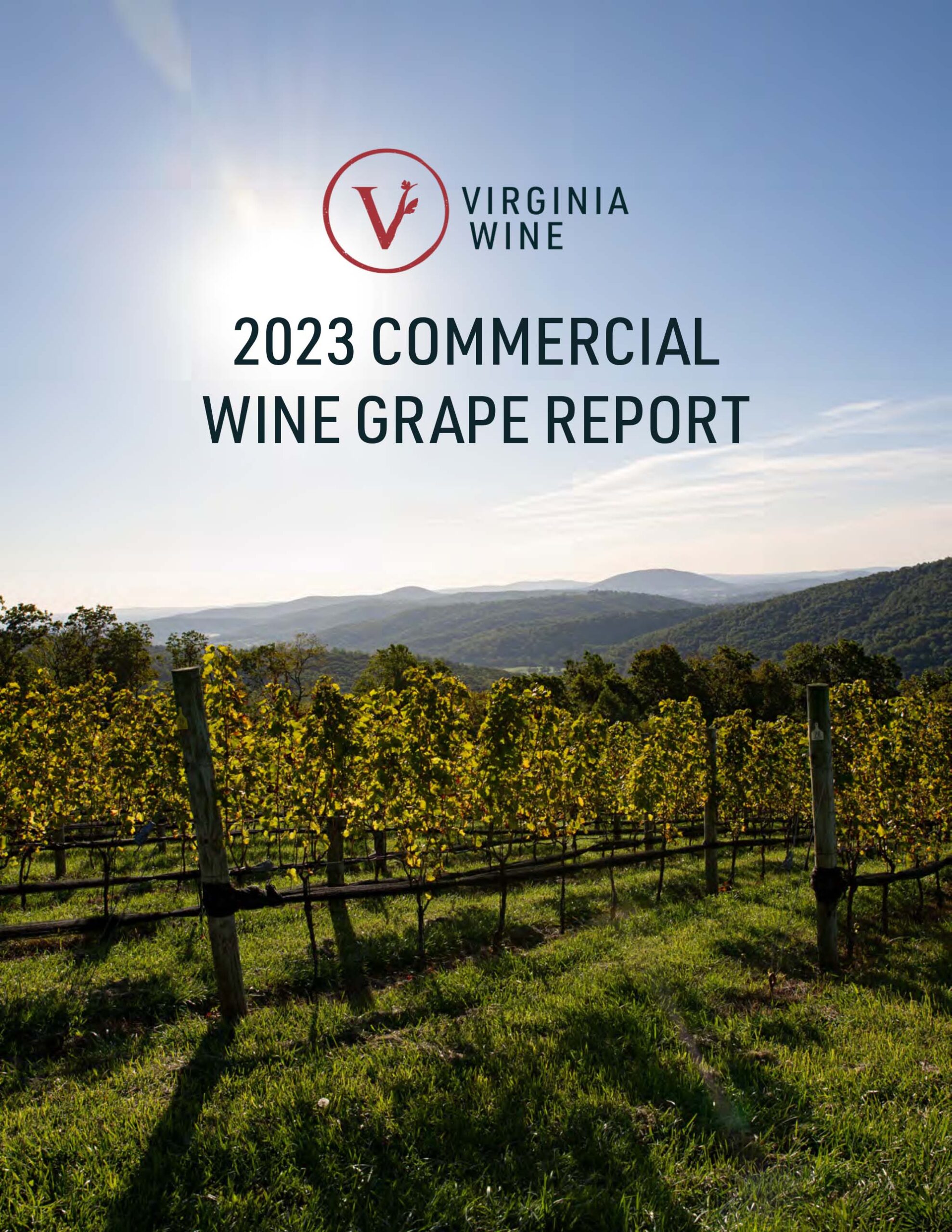
VIRGINIA, (June 11, 2024) — The Commercial Wine Grape Report, in its 14th year, represents a collaborative effort between Virginia wine trade organizations and an estimated 90% of growers and wineries, and presents in depth analysis of: production volumes, area in cultivation, and market pricing of Virginia grown wine grapes.The completion of this report signifies another successful effort by the VVA and the VWB, and the quality of the data continues to improve with each passing year.
The data set presented in the report is diverse and detailed, and includes a wealth of figures and statistics which are invaluable to current or prospective members of Virginia’s wine industry. The Entirety of the report is made available to the public and offers potential for long- and short term analysis of production figures specific to varietal and location.
The 2023 vintage was a standout year, and enjoyed excellent growing conditions and fruit quality. The trend of increasing quality in recent vintages has grown Virginia’s reputation for producing a range of high-quality wines.
Nothing in agriculture is without its hardships and even in a great vintage, like 2023, there remain difficulties that growers must overcome to remain competitive and profitable.
Lee Hartmen, winemaker with Bluestone Vineyards, recalls: “2023 yielded amazing fruit for many of us, but it was not without challenges.” Hartman references an imposing lack of precipitation in his Shenandoah County Vineyards.
Dry conditions often lauded for positive impacts on wine quality can be challenging if applied in excess, causing stress to the vineyard and a reduction in yield.
Hartman goes on to say, ”Bluestone saw a 22% drop in yield from 2022 due largely to dehydration”, which is not an uncommon observation in relation to the two recent vintages of 2021 and 2023, which were uncommonly dry. With most of Virginia vineyards farmed in absence of irrigation, this trend of warmer and drier growing conditions requires growers to adapt to variable and sometimes extreme weather patterns.
While production trends over the last decade show slow positive growth of the industry, in 2023 a small retraction of productive acreage was noted, with an 8.5% reduction in productive acreage. This reduction comes on the heels of the oversupply market in the 2022 vintage where many growers had trouble finding buyers for their grapes.
Although the industry showed a fast response to the flooded market conditions in 2022, the trend of oversupply continued slightly into 2023; and as VVA President Aj Greely states, “Several vineyards were unable to sell all of their fruit in 2023, leaving growers no choice but to leave tons of fruit out in the field.”
The challenge of oversupply in wine grape economies is something that is currently impacting nearly all major wine regions in the world; and it is clear that Virginia is not immune to these pressures. While any reduction in scale can be disruptive to the growth of an industry, it also
tasks producers to become more competitive, resilient, and refined.
The agility with which growers have responded to market pressures show the strength of the industry and, as quality becomes paramount, it is becoming clear that there is a bright future for Virginia Wine.
Over the last decade the acreage of Virginia vineyards grew by 25%, and the volume of grapes produced increased by 30%. In 2023 a total of 8,916 tons of wine grapes were produced fetching an average of $2800 per ton for vinifera varieties.
The top 3 most widely planted wine grape varieties in Virginia are Cabernet Franc, Merlot, and Petit Verdot; and, the top 3 counties with acreage in wine grapes were Albemarle, Louden, and Orange. This geographic distribution is similar to the 2013 report but trends in varietal production are now heavily leaning towards Bordeaux red varieties with Petit Verdot showing large growth in acreage over the last decade.
By following the below link, the 2023 Commercial Wine Grape Report can be viewed on the VVA website along with all previous publications of the report. https://virginiavineyardsassociation.org/commercial-reports/
Written and edited by David Eiserman
Leave a Reply